All rights reserved. No part of this work may be reproduced or transmitted in any form by any means, including photocopying, without permission in writing from the Evangelical Lutheran Church in America, Division for Global Mission, 876 West Higgins Road, Chicago, Illinois 60631.
You have in your hands an oral history narrative. It is one story in the American Lutheran Church Women in World Mission project, and as such is an important piece of the church’s global mission story. As has been said, “In an oral history, you get information you couldn’t get any other way; it is flesh and blood history.” (Edward D. Ives, University of Maine, St. Paul, Minnesota, October 16, 1987).
In October 1985, the Board for World Mission and Inter-Church Cooperation of The American Lutheran Church approved and provided funding for Stage I, American Lutheran Church Women in World Mission, an oral history and archives project.
Objectives for the project were:
The scope of the project was limited to Brazil, Cameroon, Colombia, Ethiopia, Hong Kong, India, Japan, Madagascar, Papua New Guinea, Nigeria, South Africa, and Taiwan because ALC missionary experience in other countries is either relatively recent or potential narrators have already been interviewed (for example, in the Midwest China Center project). The project proposal identified 247 women as potential narrators based on a list of all women, married or single, retired or resigned, who served The American Lutheran Church or one of its predecessor bodies in one of the countries listed above for at least 10 years, whose missionary service began, ended, or took place between 1930 and 1980.
These 247 potential narrators were divided into three groups for the implementation of the project: Stage I (38), women born in 1910 and earlier; Stage II (43) women born in 1911 to 1920; and Stage III (166), women born in 1921 and later.
In Stage I, 27 women were interviewed. The original tapes were duplicated and the narratives transcribed. All of the transcribed narratives were lightly edited and bound in the format you have in your hands. The tapes and transcriptions are copyrighted with all rights held by The American Lutheran Church, Division for World Mission and Inter-Church Cooperation. The original tapes and duplicates and the original bound narratives are deposited in the archives of The American Lutheran Church at Luther Northwestern Theological Seminary, 2481 Como Avenue West, St. Paul, MN 55108, and available to interested researchers. One copy of each of the narratives has been placed in the following libraries: Luther Northwestern Theological Seminary, St Paul, Minnesota; Trinity Lutheran Seminary, Columbus, Ohio; and Wartburg Theological Seminary, Dubuque, Iowa. Requests for copies of any of the bound narratives should be addressed to The American Lutheran Church Archives, Luther Northwestern Theological Seminary, 2481 Como Avenue West, St. Paul, MN 55108. Requests for permission to quote from the copyrighted narratives may be addressed to The American Lutheran Church, Division for World Mission and Inter-Church Cooperation, 422 South Fifth Street, Minneapolis, MN 55415 (after January 1, 1988, address the Evangelical Lutheran Church in America, Division for Global Mission, 8765 West Higgins Road, Chicago, IL 60631).
A committee of five persons guided the project: Dr. Susan Everson, Mr. James Fogerty, Dr. Helen Strand, Ms. Jane Koons, and Rev. Douglas Swendseid. At the time of their appointments to the committee, Dr. Everson was a staff member of The American Lutheran Church Women; Mr. Fogerty, archivist with the Minnesota Historical Society; Dr. Strand, a member of the Board for World Mission and Inter-Church Cooperation of The American Lutheran Church; Ms. Koons, project director for the Midwest China Center Oral History and Archives Project; and Rev. Swendseid, a staff person with the Division for World Mission and Inter-Church Cooperation of The American Lutheran Church. Rev. Swendseid served as chairman of the committee.
The project coordinator was Ms. Solveig Swendseid. Ms. Swendseid is a graduate of Concordia College, Moorhead, Minnesota, and is a former missionary in Japan for The American Lutheran Church. She is an experienced observer of the life of the Lutheran church within and outside of the United States, both as a life-long member of the church and throughout her professional work relationships.
The interviewers for Stage I were Ms. Fern Gudmestad and Ms. Solveig Swendseid. Ms. Gudmestad, a graduate of the University of Washington, Seattle, is a past president of The American Lutheran Church Women. She has traveled extensively in the congregations of the Lutheran church, speaking and providing leadership in a variety of settings. She is especially knowledgeable about the role of women in the Lutheran church. Both Ms. Swendseid and Ms. Gudmestad are skilled interviewers with wide exposure to the project’s historical period and the activities of Lutheran missionaries.
This project has collected the oral history narratives of women who served overseas as missionaries of the American Lutheran Church or a predecessor body. The decision to interview women was quite consciously made while also recognizing that there are many men missionaries who have served the church overseas and whose oral narratives would also be valuable to preserve. However, it was recognized that since the archival records of the church do not contain material about the role and activities of missionary women, it is especially important that their oral memories be preserved. Therefore, the decision was made to begin with the oral histories of the American Lutheran Church women in mission. It is hoped that the project will be completed so that the oral histories of a representative group of both women and men can be collected and preserved.
Those who have shared their life experiences and thus contributed to the history of the church’s global mission story through this project have had very different mission experiences. However, they all shared one thing; they believed that God to whom they had committed their lives would care for them in every circumstance, and they were certain that sharing the good news of the Gospel of Jesus Christ was the most important thing for them to do.
M. Douglas Swendseid
November 1987
Funding for Stage II of American Lutheran Church Women World Mission was approved in March 1987 by the Board for World Mission and Interchurch Cooperation of the American Lutheran Church. Thirty-six women were interviewed in Stage II.
The same committee that guided Stage I of the project also gave oversight to Stage II. Ms. Solveig Swendseid continued as Project Coordinator.
Ms. Fern Gudmestad and Ms. Solveig Swendseid also continued as interviewers and were assisted in the interviews by Ms. Anna Marie Mitchell. Ms. Mitchell is a graduate of Waldorf College, Forest City, Iowa, attended Lutheran Bible Institute, Minneapolis, Minnesota, and is a former missionary in Japan. She is well acquainted both with the worldwide programs of the Lutheran church and the activity of Lutheran missionaries during the period of the project.
The lives and witness of this remarkable group of women preserved in these narratives are, we believe, an important contribution to the history of the church.
M. Douglas Swendseid
June 1989
Narrator: Hildur Morck
Interviewer: Solveig Swendseid
Date: August 13, 1988
Place: Alberta
Country: Colombia
SS: It is good to be with you in your home here. Let’s begin by asking you when and where you were born?
HM: I was born September 24, 1918, near Portal, North Dakota.
SS: Where in North Dakota is Portal?
HM: It is on the border between Canada and the U.S.A. in the western part of North Dakota.
SS: Would you give me the names of your parents, please, and maiden name of your mother?
HM: My father’s name was Carl Johan Thorkildson, from Valen, and my mother was Britha Sandvold, from Sandvold in Norway, both places approximately 50 miles south of Bergen.
SS: Were they married in Norway or did they come over separately?
HM: They were engaged in Bergen and came over together, then worked for a year or more in North Dakota before being married there in Minot.
SS: Did they ever say what they did?
HM: Yes, my mother worked in a hotel and learned pastry making. As a result, we ate too many pastries when we grew up! My father learned masonry, so he did a lot of brick and cement work, besides farming the homestead that he had bought before they were married.
SS: Did you have any sisters or brothers?
HM: Yes, three brothers and three sisters.
SS: With that size family were you poor?
HM: Very poor.
SS: Do you remember anything as a child that you felt you went without?
HM: No, I was a very happy child. It didn’t take much to make us happy. We walked three miles to school, an exciting experience in the spring when new life pushed through the earth, the prairie rose and so on. And in the fall there were the ant hills, rosehips, the threshers, and the excitement of seeing our friends after the 3-month vacation. If it was too cold to walk in the winter, we went by sled, and if there was no snow, in a wagon with a canvas shelter, or in the Model-T Ford. If transportation didn’t work out, we were always disappointed. A one-room school with all eight grades was an exciting and interesting experience for us, especially when all 18 pupils could be involved in such productions as Charles Dickens’ A CHRISTMAS CAROL!
SS: Was education important in your family? Did your parents feel it was important for you?
HM: My father’s father in Norway was a school teacher and my own father was certainly concerned for the education of us but he felt there was little opportunity for us in North Dakota, especially for high school. So he worked long hours in town in order to be able to buy a new truck in 1929 and have a little camper built on the back of it. He sold the farm in October and moved us all to Oregon. I was just eleven then. My brothers had started high school in North Dakota, but with my oldest sister they started over again at Silverton, a town of 3,000 that had fine schools and churches. We rented a furnished house one block from Immanuel Lutheran Church. Dad felt he was rearing seven “heathen” in North Dakota because we had church services only once a month and no Sunday School. Perhaps that was one of the major reasons for the move although my parents were never happy on the bald prairies. They felt they had almost landed in heaven when we got to Silverton. It was located in the fertile Willamette Valley that abounded in fruits and nuts which we helped harvest in the spring and fall.
SS: So you were working for money? It wasn’t extra?
HM: For money! We earned our own school books and clothing from the summer after we arrived. My father would take us out to the fields and orchards since the Depression struck in 1929 and there was very little work for him. I can remember that we were paid three cents a pound to pick strawberries that first spring and that the price dropped a little each year, as the Depression progressed, until it hit three-quarters of a cent a pound. But what a blessing that we could go out and work! And it was fun since most of our friends were out in the fields, too. As well, we learned early how to handle our hard-earned money!
SS: Your family was Lutheran?
HM: Yes, with the Norwegian Lutheran Synod. My father was a deacon and lead bass in the choir. All of his children, except the little one, were in the choir with him at one point in time: two sopranos, two altos and two tenors.
SS: Music was important in your family, too.
HM: Very important.
SS: Do you remember any missionary or missionaries coming to speak at any of the churches, either at Portal or Silverton?
HM: I don’t remember any in North Dakota because we had moved from Portal to Columbus and it was just a small community as well. But in Oregon, yes. Missionaries would come through and two names come to me right now: Olive Hodnefield from China was a single missionary and I was fascinated by her talk. I remember thinking that someday I would like to go to China as a missionary. I was probably in high school by then. Then the Søviks came through. I remember Margaret and her two brothers. They were all three headed for St. Olaf College and stopped off in Silverton on the church’s invitation. Their father had been pastor there at one time. It was the first time I had heard Lutheran young people give public testimony of their faith in Jesus Christ. I was impressed!
SS: Do you remember the names of her brothers?
HM: No, not at this time... Yes, I believe one of them was Arne who, years later, was serving with Lutheran World Federation in Geneva. Margaret married Paul Lindell who was Director of World Mission Prayer League for many years.
SS: When and why did you decide to be a missionary? Did the missionaries coming to the church encourage you?
HM: The interest certainly was stirred up through missionaries. Andrew Burgess left a lasting impression when he told us of his work in Madagascar and taught us “Tia zaza Jeshushi” which he said in Malagasy meant “Jesus loves children”. Later, in Minneapolis, I enjoyed typing up the manuscript for one of his mission books, while working part-time for him in the Mission Office. That was while I was at Bible School.
SS: Did you go to the Lutheran Bible Institute in Minneapolis?
HM: Yes I did. After business college, I worked in government offices at Salem, Oregon, Washington, D.C., and Los Angeles, California. In L.A. I studied one year at the “old” Lutheran Bible Institute there, and transferred to Minneapolis for my second year in 1944. There my mission interest was stirred up even more. China missionary, Herman Bly, was one of my professors, and missionaries on furlough as well as candidates to various mission fields formed part of the student body.
SS: I want to go back a little bit then about your education. You finished high school in Oregon?
HM: Yes, at Silverton.
SS: There was talk of a business school.
HM: Capital Business College in Salem, Oregon. Work experience alternated with classes and after about 2 years I was given a certificate for having completed their secretarial program. They also offered bookkeeping and office machines.
SS: You thought in high school you might like to work in an office?
HM: Long before high school, and I do not know why or how. I always said I was going to be a secretary and took as many commercial courses as were offered in high school.
SS: So you studied what in business school?
HM: Typing and shorthand, spelling, penmanship and business law. There may have been other subjects which I have forgotten. It’s been so long ago! The business law course, I remember, was fascinating and the final exam took eight hours.
SS: Really?
HM: They gave no passing grade below 85. I passed that one at 85 after staying up to cram most of the night!
SS: Now getting back to becoming a missionary. When, then, did you decide and how did you get from Oregon to Minneapolis with Dr. Burgess to Colombia?
HM: At Los Angeles I was member of Our Savior’s Lutheran Church, a large, mission-minded church. Missionaries of our church sometimes spoke there. Also, missionaries with World Mission Prayer League and Lutheran World Crusade. Paul and Margaret Lindell headed up the Lutheran World Crusade movement in Los Angeles. A new friend, Virginia Antonsen, worked with them and eventually went to Colombia as a missionary. John Carlson, one of the founders of World Mission Prayer League, spoke at the Bible School one day and said there was need for a secretary in La Paz, Bolivia, to help the Director of the Lutheran work in that country. I perked up my ears.
But... I thought missionaries had to be almost perfect and I certainly was far from perfect. I also thought they had to be extremely healthy, and I had some problems with anemia. My eyes weren’t all they should be. I had had a heart murmur as a child... I thought, “No, it’s not for me.” So, I didn’t say anything to him, although I felt like shouting, “I want to go!”
The doctor who was treating my anemia in Los Angeles suggested I might do better in a northern climate. I took the tip and two weeks after arriving in Minneapolis I felt 100% better. It was hard to believe that change in climate and food could cause such a dramatic sense of physical well-being.
I finished my year there, graduating in May, 1945, and then worked eight months with the Lutheran Welfare Society at Sioux Falls, South Dakota, all the while wondering if WMPL in Bolivia had gotten a secretary for their Director. So, two years after the first encounter with World Mission Prayer League leader John Carlson in Los Angeles, I wrote to ask him if they still needed a secretary in Bolivia.
SS: World Mission...
HM: World Mission Prayer League, a Lutheran “faith mission” begun in 1939 to give opportunity for qualified lay people to do missionary work where the Lutheran Church had no established mission. They now have missionaries in ten different countries.
Eventually, I was interviewed by the WMPL Board in Minneapolis, accepted their call and prepared to go to Bolivia via Medellín, Colombia, where I wanted to study Spanish at a Presbyterian language school for missionaries. I travelled with another missionary headed for Bolivia, Constance Stennes. The world Mission Prayer League was new and still formulating policies when I went out. It had recently merged with Lutheran World Crusade and Paul Lindell became the new Director with headquarters in Minneapolis.
But... I never got to Bolivia! While thoroughly enjoying the Spanish language study in Medellín, we received word that Ernest Weinhardt, Bolivia’s field director, had died of a heart attack in Minneapolis. The missionary who was to succeed him as field director on the field didn’t feel he needed a secretary. So, my year of language study saw some turmoil both in finances and future goals. However, I learned again that “God moves in mysterious ways His wonders to perform”. I had requested a one-year student visa for Colombia from the Colombian Consulate in Chicago and assumed that that was the visa I had been granted. Resident visas for missionaries to Colombia at that time were not easy to come by, so when Dr. Gustav Guldseth discovered that I had been given a resident’s visa in my passport and not a student visa, he suggested: “I think God wants you in Colombia”. Guldseth was a medical missionary to China for some years but because he could not return there during the war years, he came on call to Colombia and was studying at the same language school. His hopes to establish a medical center on our field in Colombia didn’t materialize, however, so he returned to the U.S., but not before he encouraged the Lutheran missionaries in Colombia to recommend that the ELC Board of World Missions call me to the Colombia field as a parish worker. This came about in the next four months, and by time the call came in May, I was ready to accept it.
In July, then, I travelled with missionaries Joyce Bergh and Belva Nerlien from the language school in Medellín to Duitama, Boyacá. Here all the missionaries, old and new, were to meet in conference with Dr. Rolf Syrdal, Foreign Missions Secretary for the Evangelical Lutheran Church (of which I was a member), and Rev. K.R. Jensen, Foreign Missions Secretary for the United Evangelical Lutheran Church. I still remember some of the fine missionary orientation Dr. Syrdal gave us, drawing on his experience as a former missionary to China.
SS: Now this was at?
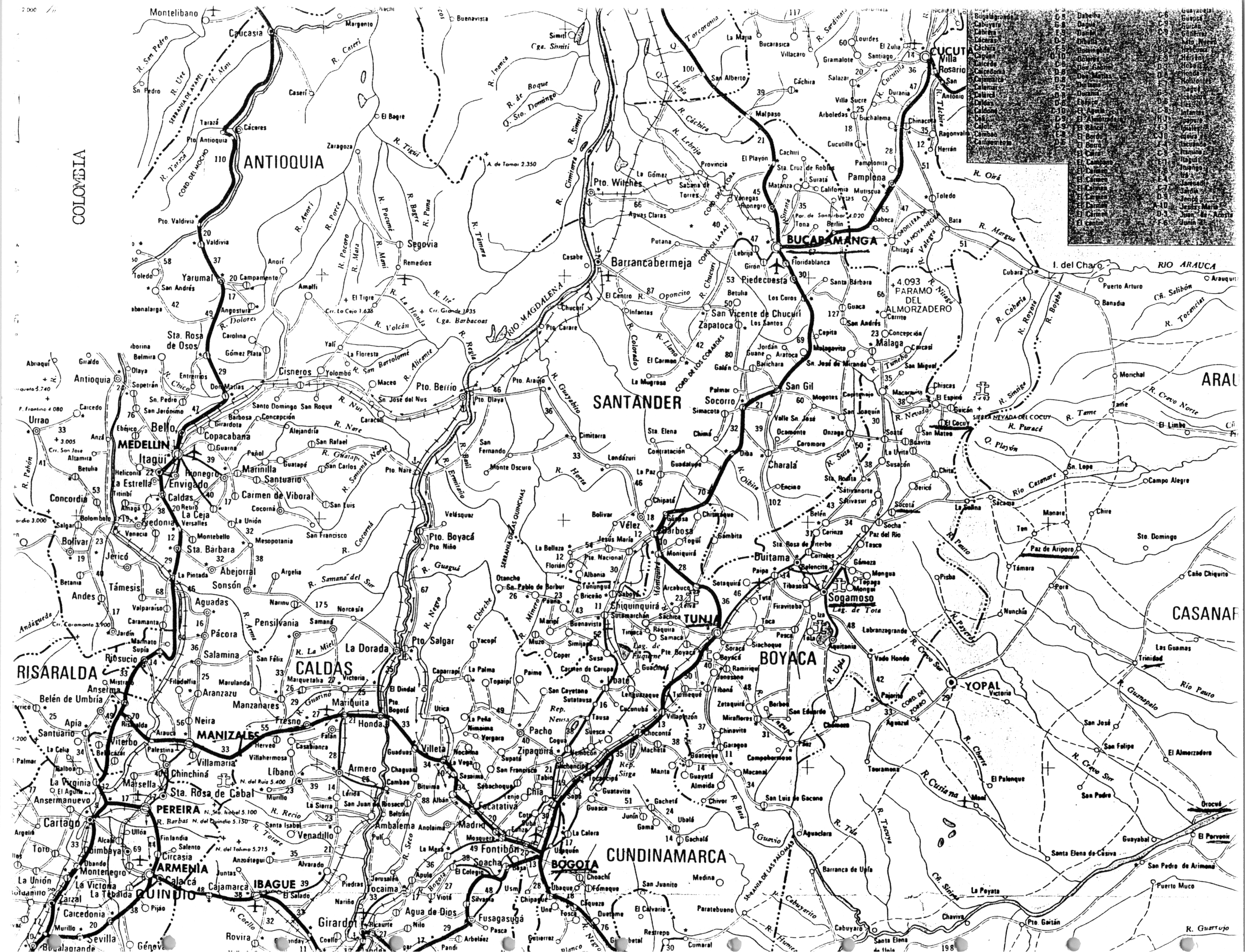
HM: Duitama, in the Province of Boyacá. It was an hour’s flight from Medellín to Bogotá and then seven hours by train from Bogotá to Duitama. At that conference I was assigned to be parish worker with Harold and Opal Olson at El Cocuy, another five to seven hours by bus out of Duitama and high up in the Andes mountains (9,000 feet above sea level). But they needed time to build a room or two onto their house before I could go there, so I was assigned to go with missionary Arnfeld Morck to La Aguada on the Plains of Casanare. This was where missionaries Gerhard and Helene Ostrem were serving and they wanted us to conduct a Bible camp for their scattered congregation, with Arnfeld teaching the adults and I the children. It was a good experience. Also, in our work and travels together we came to know each other better and established a friendship that deepened into love. My calling as “parish worker” was short-lived as I became Mrs. Arnfeld Morck the following January 5 (in 1948) at the missionary conference held again in Duitama. Arnfeld had been ordained as a pastor with the United (Danish) Evangelical Lutheran Church on June 6, 1943. He then went to Mexico for a year to study Spanish, returned to his home congregation at Dickson, Alberta, Canada, where he married his fiancée, Irene Norre. They left for Colombia soon after, arriving in Bogotá in December. In August, 1945, their daughter, Agnes, was born. Some months later her mother became very ill.
Arnfeld and two ELC missionaries were on loan to a Lutheran “faith mission” called CELMOSA (Colombia Evangelical Lutheran Mission of South America). Some ten years earlier, a group of praying people in Minneapolis had a vision for bringing the Gospel to Colombia and some of them went out as missionaries supported by friends at home. This nucleus was invited to work in territory originally opened up for mission work by the Presbyterian mission in Colombia.
By 1944, they were needing more personnel and asked the ELC and UELC to allow their missionaries, Harold Olson, Hans Thoresen and Arnfeld Morck, to help them out during this shortage with an eye to turning the work over to the joint Synods. But when the home board of the CELMOSA objected to allowing the “Church” to take over, the 3 men were asked to travel around South America to search for another field where the Lutheran Church could start a new mission. (In the end, the churches did take over the “old” CELMOSA.)
When the doctor said Irene Morck was rallying and he thought she would soon regain her health, the men set off for a 3-month mission study tour of South America. On their last lap, while making studies on Brazil, Arndt received a telegram that his wife was very ill. He returned to Bogotá as soon as he could get a flight out and en route received another message that she had died on May 15. A memorial service was held for his young wife and her body flown back to Canada for burial. This was in 1946. Arnfeld’s youngest sister, Ella, volunteered to go to Colombia to look after Agnes and,with her father,travelled to Bogotá, arriving there in January, 1947.
SS: So you went in ’43.
HM: No, Arnfeld went to Mexico in ’43 and to Colombia in ’44. I went to Colombia in 1946, and we were married in ’48.
SS: About two years.
HM: Not quite.
SS: No one came, I’m sure, to the wedding.
HM: Not from my family, but the missionary families were all there, and Arnfeld’s sister, Ella, of course. She was my lovely attendant.
SS: How did they think about your going there? And getting married and having a family?
HM: My family was delighted! I have a wonderful family and so does my husband. We feel very fortunate to have such good family relationships and support. When I met his family on our first furlough, I felt they received me well. And when we went to visit Irene’s parents, I really hadn’t thought much about our first encounter, but when I saw them coming out of the house and towards the car, it really hit me: I was coming home with Arnfeld and Agnes instead of their beloved daughter, Irene. I had never met Irene but had seen her pictures and saw at a glance that she resembled her mother very much. They received me so warmly that I felt instant love towards them which remains in my heart to this day.
SS: Now I want to have this on the tape. You said you went in 1946 and when did you return? When would you say from what year to what year was your missionary service? Now, some of this we’ll talk about later, but if you could just give me the years.
HM: From 1946 to 1976.
SS: O.k., o.k., fine. So when you began your work you were pretty good in the Spanish language, I suppose.
HM: I loved the Spanish language study and found the grammar not too difficult. But fluency of speech and idiomatic useage didn’t come until working with the children while teaching DVBS in three different places while with the Olsons. The children were patient and helpful as they unabashedly guessed, corrected and helped me find the right words.
SS: So you had little Agnes. And did you have other children?
HM: Yes, we had Alice and Anita and thought that we had had our family. But after they were all in school we wanted another child and so we had Frederick Luther on October 30, 1958. Then, we thought we should have a brother for him since he’d be all alone during grade school in Colombia while his sisters would be furthering their education in Canada.
SS: You mean, they would be up in Canada and he would be...
HM: Yes, they would undoubtedly be going to finish high school in Canada and then go on to university there as well. I was 39 when I became pregnant with Fred and knew nothing of high risk factors for mental or physical handicaps in babies born to older mothers. Nor did our doctor discourage us but instead said, “You could have six more healthy babies”, when we inquired about having a brother for Fred within the next year. So, on February 29, 1960, Robert Johan was born at home, our doctor arriving just in time to deliver him at high noon. After four days of rejoicing that another son had joined our family, it began to dawn on me that the baby only slept. He neither cried nor ate, although he had normal elimination. So, my husband called the doctor who came right over, examined the baby, forced a bit of formula down him and suggested we have a pediatrician check him over “because”, he said, “he appears to be slightly mongoloid, but I’m not sure”. Two pediatricians saw him and thought he perhaps was not suffering from mongolism, but rather, a blood incompatibility of some kind. The second one who saw him, however, may have known but didn’t wish to tell us the truth for he brushed aside my probing with the remark, “It’s too early to tell yet; don’t compare him with other babies.” An American nurse friend checked her nursing text books and suggested that he didn’t really have the symptoms described for that condition. And so we relaxed a bit, hoping and praying that there was nothing too seriously wrong with the little fellow, but always feeling a bit uneasy about his slow progress.
Robert was six months old when we went home on furlough. His Daddy had registered to study at the University of Minnesota School of Journalism, so we settled into a missionary furlough home in St. Paul in late August. We got Robert to a pediatrician within a week and he put him in Children’s Hospital for tests. It was determined that he was, indeed, a “mongoloid” or “Down’s Syndrome” baby. From then on we saw a series of specialists in the field of mental retardation and set out to inform ourselves about his problem. With the coming of Robert a whole new world opened up to us — the world of the handicapped.
SS: I was going to ask you about the education of him and the other children.
HM: All right. When Robert was diagnosed in St. Paul as being mentally handicapped, my husband heard a professor at the University lecture on the subject of mental retardation. Afterwards, Arndt spoke to him and he suggested we attend meetings of the parents’ association for the mentally handicapped. This we did and received much information and encouragement. On our return to Colombia we helped start a parents’ association which eventually led to the establishing of special education schools in Bogotá. At age 5 Robert briefly attended our “pilot school”, but since it was all in Spanish, we transferred him to a kindergarten where Colombian children were being taught English. There he learned numbers and the alphabet. Then, in 1966, we went to Canada for a year’s furlough, and my husband requested an additional three-year leave-of-absence because specialists in Colombia told us Robert would never speak unless we limited him to one language. He attended a special school in Camrose, forgot the little Spanish he knew and began to speak in English. On our return to Colombia, for another six years, he was tutored part of the time while also attending an English-language class for children with learning disabilities. He was 16 and bilingual when we left Colombia in 1976 and had two more years of special education here in Camrose before starting to learn vocational skills in a supervised work shop.
Rob is very good with his hands and has learned to do well a number of skills, but because of several physical problems may not be able to leave the security of his present situation.
Generally speaking, the four older children attended public schools in the U.S. when we were there on furlough, and private English-language schools while in Colombia. They took their last year or two of high school and all their university training here in Alberta. While still in Colombia, Fred chose correspondence courses from Edmonton for grades 9, 10 and 11, then returned to Canada for Grade 12 at Camrose Lutheran College. Agnes has her R.N. from the University of Alberta School of Nursing while Alice, Anita and Fred have their B.Ed. from the University of Alberta at Edmonton. During the turbulent politico-religious situation in Colombia, we moved several times while they were growing up, but this didn’t seem to be a negative influence on our children’s academic, social and spiritual development.
SS: What was the political thing? Can you explain that a little? I mean not... it’s probably very complex, but just a little.
HM: Yes, it’s very complex, but I’ll give it a try. Under Simón Bolívar’s leadership, Colombia was liberated from Spanish rule in 1819. It is a republic and its government resembles that of the United States with a president elected every 4 years. The president may serve more than one term, but not consecutively. Political uprisings have occurred from time to time. We experienced 10 years of civil war between 1948 and 1958 when an estimated 250,000 lives were lost. That time came to be known as “La Violencia.” The two governing parties are the Conservatives and the Liberals. The Conservatives were in power when we came to Colombia. A strong Liberal leader, Jorge Eliecer Gaitán, campaigned for election in 1948 but was assassinated on April 9th of that year. Just 4 hours before it happened, I was waiting for a ride on the very spot where he was shot in Bogotá! The Liberals had high hopes for their country under Gaitán’s leadership, and when the news flashed over the radio that he had been killed, they took to the streets in revenge.
Colombians take their politics seriously and they seem to be divided about equally between Conservatives and Liberals. Usually, the whole family will belong to the same party; hence, there was much retaliation killing: “You killed my father (or brother or son) so I’m going to kill you.” Sometimes whole families were wiped out. Also, villages were often known to be either “Conservative” or “Liberal”, and some of these were destroyed during “La Violencia”, including La Aguada where Arnfeld and I had held Bible Camp with the Ostrems.
Now, this was not only a time of political violence, but it seemed to have become an excuse to do away with Protestants as well. You see, Colombia, like much of South America, has Catholicism as its state religion. And since most of its church leaders identified with the Conservative political party, the two collaborated in trying to rid the country of Christians that were not of the Roman Catholic persuasion, for they considered them a threat to the established church and, hence, to the country. At that time Colombia prided itself on being 99% Roman Catholic. However, a Maryknoll priest at that time listed as “active” anyone who attended mass once a year, and studies indicated that only about 20% were “active” in Colombia. Since that Church forbade its people to read the Bible, the Protestants tried to reach the populace with the printed Word of God. Bible Corporteurs and Presbyterian missionaries spearheaded the Protestant mission activities about 50 years before the Lutherans and other denominations arrived. Some of the Liberal political leaders had been educated in the Presbyterian schools.
So, when the Conservatives attacked the Protestant Liberals during “La Violencia”, they not only killed Protestant Christians but also destroyed some of their churches, Bibles and hymn books.
But Catholics were also killing Catholics. It was a bad scene. Many rural and small-town folks fled to the cities to get lost in the crowds. A university student told my husband: “My Roman Catholic chaplain at the university tells me that all Liberals ought to be killed. My family has been Liberal and Roman Catholic for centuries, and now my spiritual advisor says we should all be killed because of our political leanings!”
I don’t remember how many Protestant churches were destroyed but the Lutherans lost at least 3 chapels, and several of our young people were killed, three of them brothers — the only sons of their widowed mother. At the outset of “La Violencia”, we Lutherans were some of the first Protestants to come under attack at our center in Duitama but none of our people were killed there.
SS: Duitama?
HM: Yes, Duitama. The Bible School was already established there when we arrived, and there was a small group of believers. Two missionary couples and four single workers staffed the school and church. The Jesuit priests became very upset with our presence there. When someone bought a Bible from a colporteur and read it to his family and friends, his interest in the Word of God often caused him to invite Bible teachers and missionaries to come and explain it to him and his family. This is usually how a congregation got started. Whole families and people groups would accept the Lord, establish a church, and request school teachers for their children. So the early missionaries started to train young people as teachers and evangelists. We called the school “Instituto Bíblico-Cultural” (Bible-Cultural Institute). Young people came to study after grade school, at age 14 or older, and in four years had their high school, normal training and Bible instruction. They worked hard and most became good teachers and evangelists, some going on to further education to become pastors, doctors and other professionals.
Duitama was a good geographical and transportation center, but it was also a strong Conservative center, both politically and religiously. Although a few Liberal businessmen lived there and were friendly to us, the majority listened to false accusations.
Ignorant masses were incited against us, and our Liberal friends would tell us to “be careful”, one fellow even saying that he had spoken to the Governor of the Province about our situation in order to get military protection for us.
Sometimes people would throw stones at our homes, or hiss at us as we walked down the street, with remarks like: “You ought to be burned at the stake”. “Prayer women” would stop outside each of our homes and pray something like this: “Convert yourselves, convert yourselves to the Holy Roman Catholic Church, the only true Christian Church on earth... but seven times far better would it be if you would get yourselves out of here!” When they left, there would generally be a volley of stones coming at our houses from one of the houses across the street. On one occasion my husband came home to find the prayer women chanting outside our house and he said to them: “How can I convert myself to a religion of hate?”
One night we had more than stones. We had just gone to bed when we heard heavy blows splintering our front door and shutters on our bedroom windows. We quickly dressed and got Agnes, Ella and our maid, Clementina, to go over the wall with us, taking refuge from the rain and dogs in a taxi parked there. The owner, a Conservative, heard his dogs barking furiously and came out with a powerful flashlight and his gun. Aiming his light into the taxi, he saw us and came over to say, “Why didn’t you yell? I could have killed you!” You see, it’s illegal to enter someone’s private property uninvited in Colombia. Then the man added, “I can’t figure out why my dogs didn’t tear you to bits!” Shortly thereafter, the Bible Institute boys, who bunked at our house, appeared with two soldiers and were looking for us. The boys had gone over the wall and downtown to the Army headquarters to report our plight. So the officer in charge sent along the soldiers with big rifles. They escorted us back to the house through our front doorway and we walked over a “carpet” of glass. The patio in a Spanish-style house offers light to the rooms surrounding it, and because it was cold in the mountains, these rooms were enclosed with large glass windows. All had been smashed to bits. One soldier sat down with his rifle over his knees to guard the doorway and said: “Now you can go back to bed; not even the devil can get through here.”
We had a short lull after that episode, but then a consistent campaign against us by the local priests made its impact. Even our neighbors and friends didn’t dare greet us on the streets. That saddened us.
The school year in Colombia begins in February and ends in November. About a month before school was out, my husband was preaching at the Sunday morning service from Ephesians 6 on “the Christian armor”. Suddenly, one of the students jumped up and said, “a mob is coming”. Then she closed and barred the front door. An estimated mob of 2,000 milled around in the streets outside. Their spokesman called through the closed door saying, “Today we come without a stone, warning you to get out of town or worse things will befall you.” Well, there are many, many other things I could tell, but, basically, we were threatened. The next day it happened that we were to have a...
SS: Then this crowd... disbanded?
HM: Yes, the soldiers quietly dispersed the crowd. I don’t remember how long this incident took — maybe forty-five minutes to an hour. We went back into the chapel and finished the service, ending it by singing “A Mighty Fortress is our God”.
The next day missionaries came from other areas for an Executive Committee meeting of the Mission. When we told them what had happened and that we’d have to make up our minds that week whether or not to abandon Duitama, they asked, “Why didn’t you tell us? We could have been praying for you!” We responded that we had all we could do just to keep sane in the situation. Not long before, Arnfeld and I had travelled to Bogotá and spoken to a high government official there regarding our situation and the young people we were responsible for. Colombia’s constitution grants religious liberty, but, in the minds of many priests, this must have meant religious liberty only for the Catholics. The official told us that the government’s hands were tied because the Roman Catholic Church had its own courts to try, and prosecute its own priests. “We know of priests in your area who have ordered people killed, but the civil authorities may not touch them,” he said.
My husband, being a Canadian, had reported the events earlier to the British Consul in Bogotá who was handling the affairs of Canadian citizens. The Consul said to him, “Well, if you want to be a martyr that’s all right, but get your wife and child out.”
Then he approached the Governor of the Province of Boyacá who said he would do what he could. He had already ordered soldiers to patrol the streets of the city day and night during those times of political unrest, but now they were also ordered to patrol the streets where we had personnel. However, the soldiers had a large area to cover and once they were out of sight, the stones would start flying again. Those that came into the Bible Institute were well aimed from across the street, so that they came over the front part of the roof, into the central patio and crashed into the diningroom. Several of the girls became almost hysterical with fright.
So, with the Executive Committee of the Mission, it was decided that under the circumstances it was very risky to keep the students in that place and we should, therefore, “shake the dust from our feet” and leave. We had five days in which to do this. All the students and our maid were asked to go home on the next buses leaving for their respective destinations. Because of the explosive situation some weeks earlier, we had sent Agnes, Ella and another missionary couple to stay with others away from our “hot spot”. The two young ladies destined to graduate at the end of the year went back to their homes near El Cocuy and then came to that town to be tutored by Joyce Bergh in pedagogy and other courses to round out their year of study. Arnfeld and I drove there for the graduation ceremony in late November. Many of their friends and family joined in the celebration.
During that last week in Duitama, the other single workers were assigned to work in other centers while Arnfeld and I were asked to start a work in Bogotá, Colombia’s capital city. We moved our belongings into one room, placed a padlock on the door and filled a trunk with personal needs until such time as we could return for our furniture. It was about 10:00 o’clock Saturday night when we were ready to leave, and very dark outside. My husband went downtown to get the jeep, and it seemed to take him a long time, so I became worried.
SS: I’m sorry... he went downtown...
HM: Downtown to get the jeep. Few houses had a garage, and you would not leave your vehicle out in the street unattended, for it might be stolen or stripped. So he parked it in a rented garage space down town. That night several trucks were also parked there and had to be moved in order to get the jeep out.
I wondered how the two of us would lift that heavy trunk into the jeep and hoped no trouble-makers would show up. But it was needless worry, for the Lord was watching over us and had a plan. Two soldiers appeared just as Arnfeld arrived and came in the door. They said, “Oh, are you leaving?” My husband answered, “Yes, for a while”. Then they gave us a boost to get the trunk into the jeep. We thanked them very much, gave them a tip, and went on our way rejoicing in the goodness of the Lord. We drove to Tunja that night where Agnes and her Aunt Ella were staying with missionaries Roy and Selma Malde. And, oh... it was raining, a gentle, peaceful rain — all the way. It was so soothing for our frazzled nerves! We arrived about midnight and Selma had fixed us a nice warm room and bed to crawl into. It was just so good to be away from the tense atmosphere of the town where we had been harassed for the past several months.
Duitama was perhaps the first place to have a political rally in the Boyacá province that year. I well remember the reflection of the torches in the dark sky. A newly-installed light plant wasn’t functioning yet. The mob was chanting: “Viva el Conservador; abajo el Liberal! Viva la Virgen; abajo el Protestante!” (“Long live the Conservative; down with the Liberal! Long live the Virgin; down with the Protestant!”)
Soon we heard reports of killings here and there between Conservatives and Liberals and before long the whole country was steeped in a civil war that was to last for at least 10 years.
In January, 1949, we had a full missionary conference at a beautiful camp in warm country, owned by the Presbyterians. While there we studied the situation carefully and tried to assign missionaries to areas that were still relatively safe for travel and work. Arnfeld and I were asked to look for a large house in Bogotá where we could start up the Bible School again in February and also hold Sunday services. It wasn’t long before people began fleeing to Bogotá from rural areas and small communities. So we had a much larger student body than the year before, one family sending all four of their teenage children to the School and the safety of the city.
My husband and missionary Olger Quanrud held the first Spanish Lutheran worship service in Bogotá on Easter Sunday, 1949. Besides the students and staff, one German lady and her son, who were Lutherans, came to the service. There were many other German Lutherans in Bogotá and about that time the Lutheran World Federation began sending pastors from Europe — not only for the Germans but also for the Scandinavians in Colombia. They used our facilities for many years until they were able to build or buy their own. After we had outgrown the chapel in the school, we met in a large house and then built a beautiful church under contract with Knud Langebeck who was Danish Consul then. The congregation swelled with Lutheran refugees from the Province of Boyacá where we had several centers of ministry.
New missionaries took over Arndt’s work in Bogotá and we went home on furlough in July, 1949, living at Blair, Nebraska, where Arnfeld took some courses at Dana College. Our first child, Alice, was born there on November 14.
In the summer of 1950 the girls and I stayed with Arnfeld’s folks at Dickson, Alberta, while he travelled around to the churches on behalf of missions. We were actually due to return to Colombia in July, after a year’s furlough, but because of the situation in Colombia, our Mission Board suggested we stay home and work on literature projects for awhile. So we went to Oregon to be near my family. My husband finished reviewing the Spanish translation of Hallesby’s book on PRAYER while I typed it up for the printers. Arndt was then asked to return to Colombia without his family. He left at the end of November. On January 3, 1951, Anita was born at Immanuel Lutheran Hospital in Portland.
About that time, Arnfeld was assigned to work in the city of Medellín — an hour’s flight out of Bogotá. He saw no reason why his family couldn’t join him there where many foreigners lived in relative safety. So, when Anita was 3-1/2 months, I packed our bags and flew south with my precious “cargo” to join our lonely husband and Daddy.
SS: You travelled with these three little girls. One was five and...
HM: Yes. One was five, one was 18 months and one was 3-1/2 months. But that is a story that would fill another tape. I just give God the glory for seeing us through.
SS: Tell us one, just one episode that happened with the three children.
HM: All right, I’ll tell you.
SS: I’m sure there were many, but...
HM: Well, no, not many. The story is this: I was promised a stroller for Alice in each place where we had to change planes — in Los Angeles, Mexico City and Panama. When we got to Los Angeles, I asked the stewardess if she could help me get the babies off the plane. “I’m sorry, I can’t”, she said, “I’m due on the next plane.” And she took off. But a young man sitting behind us said, “I’ll help you off”. We let all the other passengers get off first and when we got to the bottom of the stairs, a woman asked, “Are you a missionary?” When I replied in the affirmative she said, “I don’t know how I can ask you this favor, but I’ve been asked to send this box of film with you to some Methodist missionaries in Colombia.”
“Oh, yes, my husband wrote me about that”, I said, and suggested I could hang it over my shoulder with the diaper bag. It must have weighted 15 pounds, I decided!
She helped us into the airport, and when checking in at the desk, I asked, “Where is the stroller I was promised would be available for me here?”
“Oh, they make these promises, but people run off with the strollers and there aren’t any around now,” said the agent.
So this dear woman got us to the nursery where we put Anita in a crib and she suggested I take Agnes and Alice out for supper while she stayed with the sleeping baby. When we came back, she went for supper after making a phone call to cancel her plans for that evening. She stayed with us and helped us onto the plane at midnight!
When all had boarded and the plane was ready to take off, the pilot announced: “There’s a mechanical on board. We’ll try to fix it, but if it isn’t fixed in two hours you’re all going to have to find your own way to wherever you’re going. In the meantime, please get off and wait in the terminal until called.” Then he came out of the cockpit and saw me with those sleeping babies and said, “You just stay there; don’t get off. Let’s hope we get this thing going.”
People started boarding in exactly two hours! I thanked the Lord and prayed my connecting plane would still be in Mexico City when we arrived there. It was! And two swarthy Mexicans came asking, “Where are the babies?” Instead of a stroller they provided two sets of strong arms to carry these two white-haired babies to the next plane. The men were laughing with delight and had everyone else laughing with them.
So we flew off to Panama. When we arrived there at 7:00 p.m., it was hot, humid, pitch dark, and the customs area was dimly lit. Alice became frightened and began screaming. I sat her up on the counter beside the opened suitcases. Customs officials spent considerable time pawing through the fresh diapers and baby clothing in those bags, looking for I don’t know what. Two women sitting there looked like they felt sorry for me so I asked if they would please hold my baby. She was sound asleep, praise the Lord! Not a peep out of her!
Just then a woman burst in and asked, “Are you Agnes Morck?” Startled, I replied, “No, Agnes is my daughter; I’m Hildur”.
“Well”, she said, “I’m not supposed to be in here, but I had a ’phone call saying you would need help. Let me take the children and I’ll see you outside.
“You can take the baby and Agnes,” I said, while trying to calm Alice and keep an eye on the customs inspection. Finally, the officials decided I wasn’t carrying whatever it was they were searching for, and I worked at closing the suitcases that now bulged in disarray, while Alice continued screaming.
Outside, our new friend took us to her car. I had made arrangements to stay in the Panama Hotel overnight, but she told the limousine driver that we wouldn’t be staying there and drove us to her home, perhaps an hour’s drive from the airport. She placed a sheet on the floor where we deposited the babies and then cooled off with a tall pitcher-full of cold orange juice. She knew we would be dehydrated, bless her heart. Her husband was gone on a business trip, so I got his bed. Agnes and Alice slept on that sheet on the floor, and she pulled out a dresser drawer for Anita. Next morning she got us up very early and drove us to the airport after a hearty breakfast. By 7:00 we were on the plane and two hours later landed in Medellín, Colombia, where our Daddy met us with orchids for each of us. A Colombian lady from the Presbyterian church had helped him get the house ready for us. She later worked for us full time and was an excellent nursemaid for the girls. Her name was Luisa. We’ve often talked about our experiences on that pre-jet journey and acknowledged how the Lord had His “guardian angels” ready to help us at each place of need.
SS: I was going to ask about the health facilities you had there. Were you quite satisfied with the doctors and hospitals?
HM: We had very good doctors and were satisfied with their services. Of course, we lived in the cities and could pick and choose from many.
SS: The hospitals?
HM: Yes, in the cities we had very good hospitals. There were very few registered nurses, maybe one to each hospital. Most of the care was given by domestics trained as nursing aides and they were fine, compassionate people. Hospitals and drug stores were generally owned by medical doctors. Quite generally, in the small towns, the doctor who owned the drug store would be right there to suggest to customers which medication they should buy for whatever their complaint. This way the customer didn’t need to pay a doctor’s fee which he wouldn’t be able to afford anyway.
The rural areas, of course, lack both doctors and medicine. Most doctors prefer to stay in the towns and cities. For this reason, medical students are sent to rural communities for their year of internship. If they don’t wish to go, they may remain in the city but their internship is extended to two years.
SS: When we were talking earlier, you mentioned that you worked a lot with your husband in literature. Now how did you help him? How did you work with literature?
HM: Arnfeld is a poet and loves music but doesn’t sing much. So when he would translate or write an original hymn, he would ask me to check it out for “Foot and mouth disease”, as he jokingly called the irregularities. If the words didn’t fit just right with the music, he would work at it until we were both satisfied. We got out two small word editions of favorite Lutheran hymns to complement some of the reformed hymnals that we used the first while. Then, Arndt served on the Spanish Hymnal Committee that got out a red music edition which has been used by Lutherans all over South America since about 1965. I think it’s time for a new one! And, hopefully, some good hymn-writing talent will come forth from the South American people themselves.
SS: And you went to business school, so did you type, then, some of these translations and put it in book form?
HM: Yes, I typed up most of his works and proof-read all of them, as I recall, before the final printings. He also had Colombians helping him occasionally, especially when our children were small, although I do remember holding a baby on my lap while typing something of an urgent nature!
One young man, Alfonso Corzo, whom I taught typing to in Bible School, worked his way through three years of university studies by helping my husband part-time in his literature program. I remember so well how he came to be employed by us! Our Robert, because of his handicap, was requiring much of my time. In addition to being my husband’s secretary, I was also the mission hostess and expected to entertain individuals and groups who came through that city in the interest of missions, as well as out-of-town missionaries who needed a place to stay while in the city.
There were also the usual committees and pastors’ meetings from time to time, plus we had some kids that needed parenting and family fun as well! I really felt stretched at that point. So we asked for funds to hire Alfonso on a half-time basis. His father had died and his family was unable to finance his university studies. When the request for these funds went to the Mission Board in Minneapolis, the answer came back, “No, we don’t want to start a precedent of this kind.” But the Lord already had His answer ready, for just about that time a missionary came in from one of the outlying areas saying that he had received a substantial gift from someone in Montana “to be used to help university students.” It didn’t take long for the missionaries to agree that this should be used to help Alfonso who in turn would help my husband. Arnfeld then wrote about this incident to the home Board and that he was “cheerfully adding Alfonso to the field budget”. There was no negative response, so we assumed that they had agreed to this procedure. That was another one of God’s miracles, both for Alfonso and for us!
Alfonso eventually earned a Bachelor of Education Degree, and then a Degree in Business Administration while teaching by day and taking classes at night. He has been manager of the Colombia Bible Society for at least 15 years now.
As our children grew up and left home, I found more time to help Arndt when Alfonso’s help was no longer available. He always had a lot of correspondence to take care of, too, so he would dictate letters both in Spanish and in English, which I would take down in Gregg shorthand until we finally got a used Dictaphone which was a big time-saver for me.
I must say I really enjoyed being my husband’s helper and he liked to call me his “scribe”. Sitting down to the typewriter was relaxation for me, unless the job had an urgent deadline. I guess we just liked being together and our different talents and training complemented each other.
SS: So you, then, lived in Bogotá until retirement.
HM: Actually, retirement didn’t come until 6 years after we left Colombia. Because of Robert’s serious heart problem — patent ductus — his cardiologist recommended we not bring him back to Bogotá after our furlough in 1976. It was a hard decision to make; for we intended to stay in Colombia until Arndt reached 70, the mandatory retirement age for missionaries at that time. When we did decide for Rob’s sake not to return to Colombia, the Church there asked our Canadian Mission Board if Arnfeld could continue serving them in the literature program here in Canada. This was agreed to and Arndt wrote three more self-teaching doctrinal books, two on the Apostle’s Creed and one on the book of Ephesians. As I typed them up, we sent them off, chapter by chapter, to designated resource people to check them out for acceptable Spanish, pedagogy and theology. On their return, we would go over them very carefully and then Arnfeld would decide which changes should be made. Then I typed them up in final form for offset and distribution in South America. Arnfeld officially retired here in Camrose on December 31, 1982, six weeks before his 70th birthday.
SS: Are there... is there quite a bit of Protestant work now in Bogotá, or in Colombia?
HM: Oh, yes! Many different denominations now have work in that country. Since the Second Vatican Council, relations with the Roman Catholic Church have been much more favorable, and for the last 10 or so years that we were there, we had considerable dialog with them and even were able to use their retreat centers for Lutheran seminars and conventions. Pope John XXIII was very much appreciated by the Protestants of Colombia. I can remember how he asked his faithful to refer to the Protestants as “departed brethren” rather than “heretics”. Then it wasn’t long before they began calling us “brethren”. During our last year in Colombia we were invited by a group of Roman Catholic sisters to their weekly prayer meetings, and when we and other Protestants found it possible to fellowship with then in this way, we were mutually blessed.
SS: But was most of the Lutheran work done in the rural areas or was it...
HM: Yes, definitely; it was begun in rural areas and small communities. Then, during “La Violencia" we were more or less forced into the cities.
SS: Now why... would the people have to be taught to read and write in most cases then?
HM: When I came to the field, the Presbyterians as well as missionaries of the “old CELMOSA” had established schools and all the children and young people could read and write, as could their parents. There weren’t nearly enough public schools in those days, and the Evangelicals were eager to have schools where their children could study the Bible along with their secular subjects. They paid a small tuition fee for each child to cover the Colombian teacher’s salary.
SS: And that was rural...
HM: Many were out in the country, some in small towns. The chapel or church would double as a school room. The first place I taught DVBS in 1947 was straight up the mountain from El Cocuy, about an hour’s horseback ride over a rocky trail. When the Gospel came to that valley, most of the families embraced it, so we had a good congregation of faithful Christians there. One couple built a large house and offered the ground floor for school and chapel purposes while they lived on second floor. By our standards, the farms those people lived on were very small and rocky. But they were independent farmers and no one seemed to go hungry. I have such fond memories of my first DVBS experience there.
SS: Now would any of these children... were they just real tiny, or would any of them have been in school?
HM: All of them had been in school and could read and write. Most started school between six and eight years of age, and because Spanish is a phonetic language they were good little readers after just one year in school.
SS: But the government schools had not been established?
HM: Well, yes, there were some but not nearly enough. In the rural government schools, one teacher often had fifty to sixty pupils in one room and teaching from grades 1 to 4. There were many more private schools.
These were generally in the towns and cities. People who could afford the tuition chose to place their children in these schools for they felt they were superior to the public schools. And even we Lutherans started parroquial schools in the city of Bogotá so that our children wouldn’t be harrassed on account of their religion. But these are no longer operating due to the improvement in religious climate. Also, after the civil war ended, the government made an all-out effort to make improved public schooling available to children all over Colombia.
SS: Let’s talk a little about the women in the community. Did you become acquainted with many of the women? Did you become friends with any of the women, or were you busy with your work in your home and translating, so you didn’t have a lot of contact with the people outside of the home?
HM: That’s an excellent question. It’s a very good question, because I myself came to the realization that it wasn’t until my children were practically grown that I mingled enough with the people so that I could call them friends. I was a foreigner to them and they were foreigners to me as long as I was looking after my children and helping my husband in his office. The only time I was with the Colombian women was on Sundays at the worship service, and you don’t get to know anyone that way.
When the children were old enough to go to Sunday School I volunteered to be a “teacher at large”, filling in wherever a teacher was needed, and that way got acquainted with children of all ages and which families they belonged to. Then, when Alice and Anita were 12 and 11, I started a children’s choir and got even better acquainted with them. For three years, choir practice was every Sunday at 9:00 a.m.; Sunday School at 10:00, and worship at 11:00 where the children offered special music from time to time.
Soon I became involved with the women’s meetings on Fridays and then volunteered to help in the kitchen when there were conventions or congregational dinners and we’d prepare food for 200 people. That’s where we really got to know each other — over the dishpan or chopping fruit for fresh fruit cocktail! They were such good cooks with many clever ideas. As I became better acquainted with those dear women, I realized what I had missed all those years... getting to know them on a one-to-one basis. I really made up for lost time the last years and gained some very good, close friends with whom I still correspond.
SS: Well, now, what about the handicapped children there. Were parents ashamed of them? Were they kept in the home, like you hear sometimes that, you know, that they were hidden?
HM: Yes... like here... many were hidden there, especially amongst the upper classes. But we noticed in the poorer families that those who survived infancy often were used as domestic help. It was interesting to notice amongst the well-to-do people, though, that they didn’t wish their handicapped children to be trained as domestics! But we definitely got them out of the back rooms when our parents’ association, aided by medical professionals, started a campaign to treat them as real persons. I started a Mothers’ Club and there were 10 of us at the first meeting in our livingroom where I asked each one to tell about her child. Years later, some of them told me: “We never talked of our handicapped child outside of our home, except with the family doctor. But you got us talking that day we first met in your home, and we haven’t stopped talking since!” Along with some of the medical doctors in our Association, these women organized teams of four to travel to other cities and speak to parents of the handicapped, encouraging them to also get organized and start doing something positive for their children. The doctors also gave seminars to university students who were interested in special education, and served on the board of directors for our association. The mothers got busy on fund-raising projects while some of the fathers managed to persuade the Department of Education that the handicapped also needed funding for educational opportunities. One of the mottoes they circulated was: “No me compadezcas; ayúdame” (Don’t feel sorry for me; help me!).
Finally, we rented the Lutheran Synod’s old Bible School building, bought some used furniture, had a painting bee and got our pilot school off the ground with 50 pupils having handicaps of every sort and from age five to fifty-five. What a challenge! But those four fine teachers, each with a teacher’s aide, were just super. University professors would bring groups of students to observe them during the ensuing years. As a result, a number of private schools for the mentally handicapped sprang up and teachers in public schools were helped to spot learning disabilities amongst children in their classrooms. Because of our son Robert, Arnfeld and I got involved in a very interesting and educational project. I’d say we gained much more from our involvement than we gave!
SS: You said he reads and writes.
HM: Yes, Rob reads quite well, but he doesn’t always comprehend abstract ideas. He writes and spells very well and enjoys a good game of Scrabble. He is a loveable and outgoing person, as so many of his type are. And he loves his church where he takes his turn as an usher as well as a communion assistant. People are so good to him there and he won’t miss a Sunday service if he can help it. One of the highlights of his life came last July when he served as Bestman at his brother’s wedding.
SS: Now, I’m just... we were talking a little bit about the women, you know. And you were busy with your work, and things. However, what did you think about... or what was the attitude of society towards women?
HM: Very definitely a third-world attitude — that the man was superior to the woman. The woman was his servant once he married her, and in some cases he treated her like a slave. Men often had mistresses and their wives had to tolerate it. But I realize that some of these attitudes exist in North America as well.
We did notice a general change in attitude, though, when men accepted Jesus as Lord and started to live according to His Word. We know many beautiful couples who live and love as equals because of the Gospel that they have embraced. But society in general placed men above women in Colombia, for sure. We even watched Colombian lawyers of both sexes debating on television the inequalities that existed in Colombia while we were there, perhaps in 1975 or 1976.
SS: But, as women then, they had maybe not such an easy time.
HM: That’s right. The majority did not have an easy time. And we noticed that many men seemed to adore their mother while treating their wife badly. This was something about their culture I didn’t understand, nor did I think to inquire into it while there.
It could be the fact that their own mother brought them into the world, nurtured and provided for their needs and, therefore, the “bonding” is still there in adulthood. It’s only a guess.
SS: Now, in the Mission, you talked once in a while about missionaries getting together, at a Mission conference. Did you vote in the Mission Conference? Did the women vote in the conference?
HM: Well now, let me think... If I remember correctly, all the “called missionaries” had a vote, men and women alike. Wives of missionaries were not extended a formal call and therefore not salaried. We were there to care for the needs of husband and family. I don’t think we had a vote to begin with, but somewhere along the line we were given the right. Also, almost from the beginning, women had voting privileges in local and national church meetings. The Evangelical Lutheran Church — Synod of Colombia became self-governing in 1958 and I believe women could vote even before that time in their local congregations.
SS: Well, I’m sure there are many other questions I could have asked you for all the years that you spent there in Colombia. You have experienced many things. But I think we will close, but before I do that, or we do that, I want to thank you for participating, for taking the time to talk with me and getting this on tape. And thank you on behalf of Global Mission of Evangelical Lutheran Church of America and for your part in this oral history project. And I guess just in closing I will ask if there is, you know, something you would like to say, that you might think of...
HM: Yes... I would like to say that in two hours it is hard to choose what to cover in 30 years of history. But, from day one I loved most everything about Colombia except the violence and persecution. But we have forgiven the perpetrators of such evil.
We have always tried to present the good things that happened in Colombia and I hope I wasn’t too negative today.
We feel blessed to have had a small part in training teachers, lay people, evangelists and pastors to get the spoken and printed Word out to the populace. Many times, of course, we wished we could go back and start over again, correcting some of the mistakes we made. Hindsight is always so much clearer than foresight!
For me, personally, it was a privilege to be not only a “helper” in the Lord’s vineyard, but also my husband’s “helpmeet” and our children’s mother. Of course, I am keenly aware of my sins of omission as well as commission over the years, but since I can’t go back in time to make amends, I accept the merciful forgiveness of our Lord and Savior, Jesus Christ.
SS: Thank you so much. It’s been very interesting. I’ve learned many things and certainly appreciate your willingness to help.
HM: Thank you for the opportunity to meet and visit with you and your husband... It’s been many years now since we were in Colombia, so I probably forgot some of the more important details. And it wasn’t very well coordinated...
SS: No, it went very fine, very fine. Thank you.
HM: You’re welcome.